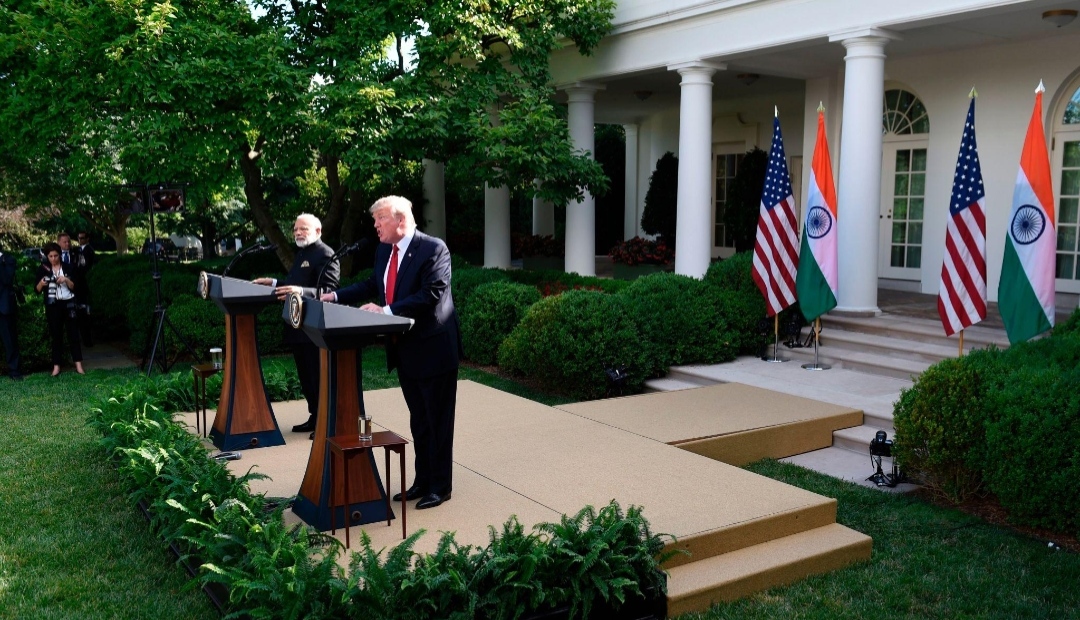
Washington, DC, June 5: United States President Donald Trump on Thursday expressed optimism about the prospects of a new trade agreement between Washington and New Delhi, stating that negotiations are progressing positively and describing Indian Prime Minister Narendra Modi as a “good friend.”
Speaking to reporters at the White House, Trump said he expects the two countries to reach a mutually beneficial trade deal in the near future.“For years, India took advantage of the United States. They charged us tremendous tariffs and paid nothing. Now it is the exact reverse, and we are making a lot of money with India. But we will get to a deal because I like your Prime Minister a lot. He is a good friend of mine, and we get along well. We have a good relationship,” Trump remarked.
His comments come amid renewed trade tensions following the announcement by the United States of additional tariffs on imports from several economies over concerns related to forced labour practices.
Earlier this week, the Office of the United States Trade Representative (USTR) unveiled a new tariff framework that could impose an additional duty of either 10 per cent or 12.5 per cent on imports from dozens of countries. The move follows investigations that, according to USTR, found that goods imported from multiple economies may have been produced using forced labour.
India was among 54 economies identified by the USTR as having failed to adequately prohibit or enforce restrictions on the importation of goods produced through forced labour. The list also includes countries such as Australia, China, Israel, Japan, Qatar, Russia, Saudi Arabia, Singapore, South Korea, Sri Lanka, Switzerland, Taiwan, Thailand, Türkiye, the United Arab Emirates, and the United Kingdom.
According to the USTR, countries that already maintain some form of forced-labour import restrictions or have pledged to adopt such measures through trade agreements could face an additional tariff of 10 per cent. Other economies may be subjected to a higher duty of 12.5 per cent.
The proposed measures also include a textile import mechanism that would allow a specified volume of apparel and textile products from certain economies to enter the United States at a reduced tariff rate under Section 301 provisions.
The action has been initiated under Section 301 of the Trade Act of 1974, which authorises the US government to take trade measures against countries whose policies or practices are deemed unfair or harmful to American commerce.
The USTR further identified six economies including the European Union, Pakistan and Canada for allegedly failing to effectively enforce existing prohibitions on the importation of goods produced through forced labour.
Despite the latest tariff measures, Trump’s remarks indicate that Washington and New Delhi remain engaged in efforts to strengthen bilateral trade ties and conclude a long-awaited trade agreement.